Thursday, October 29, 2009

Halloween Candy Sent to Troops Overseas
One of many creative solutions to this issue is the "Halloween Candy Buy Back" program. Participating dentists will buy candy from kids (usually for $1 per pound) and send it in care packages to troops overseas.
Participating dentist Linda Grove has an interesting counterpoint. In an article, she states her hope that toothbrushes and toothpaste will be sent along with the candy. "We don't want [the soldiers'] teeth to rot either."
Use your trick-or-treating power for a good cause!
Sleepless in West Virginia
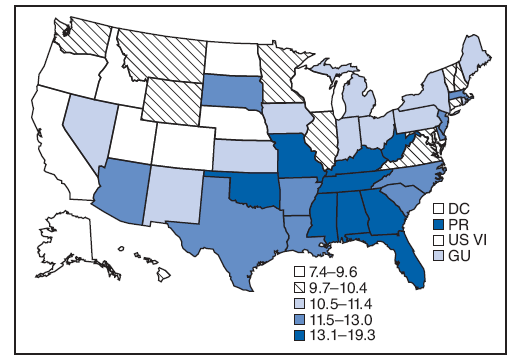
Several factors have been suspected to be the cause of this restlessness. West Virginia ranks high in health problems such as obesity and heart disease, which could lead to trouble sleeping. Also, many people work in coal mining, which results in odd work shifts and financial worries.
Surprisingly, California and New York, two states one would expect to be awake more, actually slept slightly better than the national average. Of course, the survey has the potential to be biased, since it did not include people who only use cell phones (participants were contacted via phone). It also only included those who are at least 18 years old.
I would be interested to see more information about sleep by age, or about students, since I know school plays a large role in sleep deprivation in students.
Tuesday, October 27, 2009
The Bay Bridge is Falling Down
The parts that fell were apparently part of the emergency repairs done that delayed the bridge's opening back on Labor Day. Three vehicles were hit, and I hope no one was seriously injured.
I feel lucky for getting out of there before the collapse, sorry for those who didn't, and slightly less safe traveling over bridges.

Controlled Capitalism
The ideal economic system is based on the sheer power of capitalism, combined with government regulations to keep the public's interests at hand.
Capitalism functions remarkably well for a system based on self-interest. This, as Adam Smith would explain, is caused by the guidance of an “invisible hand”—those who seemingly serve their own interests by trying to make a profit serve the public too, by trying to get consumers to buy their product. Ludwig von Mises agrees with this idea, stating in “Capitalism Guarantees Human Freedom” that “He who serves the public best, makes the highest profits.” By allowing for competition on the part of business owners, capitalist economies give their people an array of choices in products. The consumers choose which businesses get to keep running by choosing to buy their products. As von Mises puts it, “Profit tells the entrepreneur that the consumers approve of his ventures; loss, that they disapprove.” In this system, anyone who has an idea for a product is welcome to simply try it out on the market. If people like it, they will buy it, getting a better product for themselves and keeping that business running. It is a win-win situation.
This is the incredible power of capitalism—entrepreneurship. Without developments in business and technology, and a market in which to try out new ideas, a nation cannot keep up with the rest of the world. The engine of capitalism never slows as long as the capacity for human creativity continues to expand. It is vital to a nation’s economy that this power not be stifled.
However, there are instances in which capitalism becomes corrupt, rather than having the interests of the people at hand. If, for example, a company gains a monopoly in a particular industry, they can raise prices with no competition in order to increase profits. In addition, capitalism has been accused of creating a materialistic society instead of putting the focus where it should be—the welfare of the people. A 1985 issue of The People says that, “Far from being a machine for bringing people out of poverty, capitalism perversely condemns millions to poverty in the midst of the means sufficient for creating an abundance for all and in the midst of the obscene luxury enjoyed by the capitalist minority.” This is a valid point. Something is clearly amiss if the wealth gap in a particular nation is so large.
The government exists to serve the best interests of its people (although it sometimes appears otherwise). Therefore, there are times in which government intervention is needed in the economy. The United States is a good example of a nation with an economy based on capitalism with government regulation. We have agreed as a country that there are some services that everyone should have access to and have made those public. Some examples of these services are schools, fire departments, police departments, libraries, and the current debate over health care. In addition, laws have been passed on things such as food labels, in order to educate the consumer in making choices about their health.
Another circumstance has recently arisen under which the government will be required to step in more often: environmental degradation. Consumers tend to buy the cheapest products, rather than necessarily supporting new green technology such as solar panels, which can be more expensive. In order to do something about the environment, it will be necessary for the government to subsidize environmentally friendly technology and tax harmful practices.
In conclusion, an ideal economy regulates some things without stifling the incredible power of entrepreneurship.
Saturday, October 24, 2009
Startling Results of Global Warming Survey
The results state that, when asked, "Is there solid evidence the earth is warming?" only 57% answered, "yes," down from 71% in April 2008. This is accompanied by a 12% increase in the number of people who answered "no."
Furthermore, when asked how serious a problem global warming is, a 9% decrease was reported in the people who answered "very serious," with a 6% increase in those who answered "not a problem."

To me, this illustrates that the ignorance of the American people is a "very serious" problem. I realize that, despite the flood of publicity that global warming has received in recent years, there are still far too many people out there who deny that the phenomenon exists. This is saddening, because at this point there is far too much evidence for arguments against the existence of global warming to hold much water. However, I understand that not everyone has been sufficiently exposed to this information.
What alarms me about this survey, therefore, isn't only the fact that nearly half of the American population doesn't believe in global warming; it's the fact more people deny that global warming exists than a year ago. What's going on here?
Monday, October 19, 2009
Busted

He offered to meet with a person he believed to be an Israeli intelligence officer (actually an undercover FBI agent) and, in return for pay, left top secret information concerning major U.S. weapons systems, warning systems, and defense systems.
It's sad that a man in which our government and, by extension, country have trusted so much is willing to betray that trust in exchange for money. At least now he'll be dealing with the consequences, and I know I'll feel a little bit safer about our national security.
Sunday, October 18, 2009
Don't Miss Chance at Copenhagen, Brown Warns
He warns, "In every era there are only one or two moments when nations come together and reach agreements that make history, because they change the course of history. Copenhagen must be such a time. There are now fewer than 50 days to set the course of the next 50 years and more."
Part of human nature is to disagree with each other. Sometimes, that's a beautiful thing. It shows that we can think and decide for ourselves. At other times, it seems idiotic or dangerous, depending on the circumstances.
This is a case where the governments of the world need to come together, and fast. The main issue here seems to be environmental concerns clashing with economic ones. Let's hope our world leaders are able to come up with some solutions before we run out of time.
The Dangers of a Media-Based Society
Authorities became suspicious when the boy's older brother said that he saw the boy climb into the balloon before he untied the tethers, which was clearly not the case. However, he was consistent with the story. More suspicion arose when the boy, when asked why he didn't respond to people calling his name, responded, "You guys said we did this for the show."
View the awkward moment:
It is believed that the parents staged the event in order to become reality TV stars.
This event fascinates me, because it shows what a powerful force the media is in our society. Undoubtedly, there are good things that have come from it. More people are aware of and involved in current issues. People are allowed to speak their minds and expose injustice.
However, issues such as this one illustrate the flip side: people use the media to manipulate the public for their own self-interest. What makes this particular case even more horrifying is that it centers around a six-year-old boy. It is difficult enough to be in the national spotlight, particularly at such a young age, without being asked to lie to millions of people so that mommy and daddy can have their moments of fame.
If we lived in a society where no one paid attention to television or the internet, these sorts of schemes would never be dreamed up in the first place, because they would have no chance of working. But for better or for worse, we're all tuned in.
Thursday, October 15, 2009
Dow Reaches 10,000

A quote I found interesting from the New York Times article that provided me with this news is one of the simplest I've ever read. Tom Fitzpatrick, chief technical analyst at Citigroup Capital Markets, simply says, "It's psychological."
This is really what those increasing numbers are telling us. People have more faith in the market. Once people begin to spend their disposable income, the market spiral becomes one of growth rather than a downward spiral.
Let's hope our confidence continues to grow.
Wednesday, October 14, 2009
Obama Wins Peace Prize
I don't know what the Committee's thoughts were when the name Barack Obama surfaced. Perhaps, as some say, they gave him the prize as a reminder of actions he needs to take to prove that he is worthy of the award.
What I do know is, he handled it well. As the video below shows, he accepted the award humbly, even admitting, "To be honest, I do not feel that I deserve to be in the company of so many of the transformative figures who've been honored by this prize." He resolves to take the award as a reminder of what needs to be done, rather than rejecting it and possibly offending the Committee and others.
Well done, Obama.
Friday, October 9, 2009
Taliban Will Be Involved in Afghanistan's Future
He has realized that the Taliban is too ingrained in Afghanistan's culture to be completely defeated, and that the ties between the Taliban and Al-Qaida are increasingly weaker and for different ideals. The aims of the Taliban are far less of a threat to the United States.
Let's see if we can actually manage to pull ourselves out of a war if it doesn't concern us.
Thursday, October 8, 2009
Obama to Address Gay Rights Advocates
As far as the gay rights movement goes, I still find the fact that the majority of voters in California oppose same sex marriage more worrisome than that the president hasn't been able to address the issue yet. Although it would certainly help things if Obama was making a huge effort to address prejudice against same sex couples, the change in opinion really needs to happen in the population.
Education Efforts Pay Off
Admittedly, many states have really low standards as far as "proficiency" on statewide tests go, and variance by state is sure to skew national results somewhat. In fact, there are a lot of things about the education system in this country that I think need fixing. But perhaps this marks the beginning of a larger transformation in the future. It's good that there is some improvement to show for current efforts.
Taliban Says: We Pose No Threat
Some of Obama's advisors say that he should shift the focus to Al-Qaida in Iraq, since they pose more of a threat. Some even believe that, if the Taliban's intent is indeed benign, there is the possiblity of opening dealings with them.
However, others argue that the link between Al-Qaida and the Taliban remains strong, and that if the Taliban were to gain power in Afghanistan, it would become a safe haven for Al-Qaida.
Clearly, it's too soon to tell one way or the other yet. A shift in focus might be the way to go, but we should also be wary of letting our guard down too soon.
Is Archaeopteryx Really a Bird?
By looking at the fossil with a high-powered microscope, scientists believe that archaeopteryx grew at a rate faster than reptiles, but much slower than modern birds, and had a slower metabolism.
So archaeopteryx may not be a bird, but still appears to be a transitional species between dinosaurs and birds. It's just at a different phase in the transformation than we originally thought.

Tuesday, October 6, 2009
AT&T's New Policy
Previously, users could not connect with Skype over the wireless network. Recent policies regarding programs that use internet calling, with or without using the caller's minutes, have varied by situation.
Chief executive of AT&T’s consumer and wireless unit Ralph de la Vega said in a statement, "Today’s decision was made after evaluating our customers’ expectations and use of the device compared to dozens of others we offer."
This is a typical aspect of the market economy-- executives make decisions based on consumers' ever-changing desires, pursuing self-interest by providing goods that people will want to purchase. It gets really interesting, however, when we not only have competing companies, but also companies, programs, and services that overlap. Today's population, connected to the internet, find the borders between various aspects of technology (for example, the telephone, video, and internet) to be more seamless than ever.
I'm interested to see how other companies cope as technology continues to change.
Thursday, October 1, 2009
We're Split 50/50 on Abortion
Being pro-choice, I find these changes to be worrisome. I can understand that many believe killing is wrong, even in the case of a person who hasn't been born yet. However, if abortion were to become illegal, it would create many more problems than it would solve.
What kind of life would that child being born have? Yes, it's possible that they would live a healthy and prosperous life, but the chances are against it. Women who choose to have abortions are in extremely difficult (abusive, financially tight, or unstable) situations. Not only would having the child be hard to handle for her, the child would be brought up in an unstable environment, assuming he or she isn't put up for adoption.
Raising a child is a huge task, arguably the most important one in a person's life. Those who are not prepared to take it on should not be forced to. There are millions living without enough food, shelter, or water as it is. Children being born to parents unprepared to care for them would have disastrous consequences, putting more strain on both the individuals involved, and the world as a whole.
If abortion is against your religious beliefs, I'll respect that. If you don't support abortions, don't get one. Just don't force others to do the same.
What About the Long-Term?
The program was a great success while it lasted, but now what?
Adolfo Laurenti, senior economist at Mesirow Financial in Chicago, points out that, "these type of interventions, they are not really strong enough to really support spending in the long term." Despite the success of Cash for Clunkers, we need to continue to think about the long term. Perhaps government intervention can get the economy started again, but people need to continue spending in order for the economy to truly get back on its feet.


