Tuesday, March 30, 2010

Decline in Mink Imports
An article about PETA's anti-fur campaign mentioned a statistic that I found heartening.
It said, "Mink imports to the U.S. decreased by 30% in 2009 from 2008 levels."
However, the article failed to draw conclusive results as to whether and how much PETA was responsible for the decline. I suspect that they were at least partially responsible, but there were a number of other factors involved, including improvements in the production of faux fur.
Whatever the reasons behind it, I find the decrease in mink imports to be a hopeful sign of public awareness and action.
Animal Sanctuary in Colombia

The animals housed at Ana Julia Torres's Villa Lorena sanctuary in Colombia are "rescued largely from drug traffickers and paramilitary warlords, as well as from circuses and animal-smuggling rings," a New York Times article states.
Each animal has a unique story, and together they provide insight into the abuse associated with drug wars in that country. To further complicate matters, authorities are currently operating under laws that make catching exotic animal owners difficult. There is no prison term for people who mistreat animals or own rare species, and wild animals can only be seized while in transport.
I'm glad to live in a place that has relatively strict animal rights laws, and I hope that other countries, such as Colombia, can enact similar legislation soon.
Celebrity Power
Carrie Underwood recently donated $10,000 to Bideawee to show her support for animals and animal shelters.
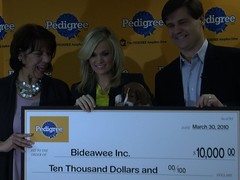 Renee Collins, Bideawee's adoption center manager, hopes Underwood will be able to persuade her fans to adopt pets from shelters, rather than pet stores or breeders. “We’re hoping that her popularity will rub off on us and get people who like her to come in and check us out,” she says.
Adopting a dog or cat just to imitate a favorite celebrity may encourage people to adopt even though they are really not able to provide a good home for the animal. Despite this, using one's celebrity status for the benefit of such a cause is very helpful. With shelters put under even more pressure lately due to the recession, publicity is needed. Hopefully Underwood's positive example will bring the plight of animal shelters across the country to people's attention.
Renee Collins, Bideawee's adoption center manager, hopes Underwood will be able to persuade her fans to adopt pets from shelters, rather than pet stores or breeders. “We’re hoping that her popularity will rub off on us and get people who like her to come in and check us out,” she says.Adopting a dog or cat just to imitate a favorite celebrity may encourage people to adopt even though they are really not able to provide a good home for the animal. Despite this, using one's celebrity status for the benefit of such a cause is very helpful. With shelters put under even more pressure lately due to the recession, publicity is needed. Hopefully Underwood's positive example will bring the plight of animal shelters across the country to people's attention.
Too Dependent on Apps?

This article did a wonderful job of showing exactly how huge a part of people's lives iPhone apps have become.
It describes one woman: "She has an app to wake her, a few to provide the day's news, one to check her bank account, another to make a grocery list, two to track her diet and one to get the weather. She has an app for baseball scores and an app for movie data. One app lets her program her DVR from afar. Another helps her unwind with quizzes about famous artworks. And that's just a portion of her daily intake."
Anyone besides me find this to be a little frightening? Don't get me wrong, I completely understand the entertainment and helpfulness that apps provide. I've heard many an iPhone owner mention that they would be lost without apps.
However, I'm still a bit wary of the very nature of the iPhone. It puts almost all the programs needed for day-to-day use in one place, which is convenient, but could easily cause many problems. Becoming dependent on an iPhone is putting all your eggs in one basket. What happens if something happens to the iPhone?
Participating in Earth Hour on Saturday reminded me how dependent we are on electricity-- it's impossible to do nearly all the things I do for school or home life without it. I'm sensing the phenomenon happening with iPhone apps. As helpful as they are, let's not forget how to live without them.
Wednesday, March 24, 2010
Ito En Stops Animal Testing

Ito En, the world's largest green tea supplier, has stopped using animal testing for its products. A spokesperson stated, "...we believe protecting animals is a global trend."
As someone who drinks green tea and supports animal rights, I'm happy to hear this. I understand that it is difficult to find ways around animal testing in some cases, in order to make human safety a priority. However, if it is at all possible to make a product without testing it on animals, animal testing should not be used.
At Avian Rescue Corporation, I've gotten to know two Amazon parrots who were rescued from a lab at a university. One remains very calm, but the other, as the CEO of ARC says, "must have been put through hell." He is extremely frightened around people. It's difficult to even approach the cage, because he'll become so scared that he tries to fly off his perch and lands roughly on the bottom of the cage. Although it's been seven years since he left the lab, he remains mentally scarred and will most likely never get to be adopted.
After seeing the effects of animal testing in person, it's difficult not to oppose it, so I applaud Ito En's move away from animal testing.
Military to Loosen "Don't Ask, Don't Tell"

This article talks about the expectation of an announcement Thursday that the military will relax the enforcement of the "don't ask, don't tell" law.
'"[Defense Secretary Robert] Gates and Adm. Mike Mullen, the chairman of the Joint Chiefs of Staff, told a Senate committee on Feb. 2 that they agree with Obama and would take steps to prepare the military for the eventual repeal of "don't ask, don't tell,''' according to the article.
The job of actually repealing the law rests with Congress, where it looks like there is disagreement over the issue. Many Republicans, and a few Democrats, oppose repealing the law. Where have we heard strong opposition like this before?
It frustrates me at times like this that Congress is structured to be so slow-moving. However, although there seems to not be a big rush for repealing "don't ask, don't tell," at least our lawmakers in Washington are headed in the right direction. It just doesn't make sense to me that men and women willing to fight for our country should be forced to hide a significant part of their identity or be denied that opportunity. Over the years, we've integrated women and African Americans into the military when they were previously banned. The next logical step is offering the same opportunities to gays and lesbians.
Endangered Animals in Vietnam

This article talks about the alarming situation in Vietnam regarding animal trafficking and consumption of wild meat. Essentially, it lists a lot of statistics.
Here are some of the most frightening to me:
- nationwide demand for wild meat is about 4,500 tons per year
- six tons of elephant tusks were found trafficked in from Africa
- In the last two years, authorities have discovered over 7,600 animals being trafficked
In order to resolve this seriously out-of-hand issue, education must be made a priority, particularly in rural areas. In addition, penalties for trafficking should increase and more staff should be devoted to looking for those guilty of animal trafficking or hunting crimes.
Marijuana Included on November Ballot
An article caught my eye that stated that the issue of marijuana legalization will be on the ballot for the November 2 election, having gained enough signatures from backers.

I'm interested to see what the support looks like for this measure as voting draws nearer, and what kinds of advertising comes from both sides of the movement. Both sides have good cases to make. On the one hand, as California Mothers Against Drunk Driving spokesman Silas Miers said, "With legalization of recreational marijuana use, impaired driving, fatalities, injuries and crashes will go up, and we don't want to see that."
However, in my opinion, the benefits outweigh the negatives. Primarily, it would help out a great deal with easing California's debt. It would relieve some of the burden on our prisons, and taxing the drug would provide the government with revenue. Furthermore, marijuana is only as dangerous, or possibly less dangerous, than alcohol and tobacco, both of which are legal. And the prohibition of marijuana for medical use is leading to the suffering of many patients.
I'm interested to see what the support looks like for this measure as voting draws nearer, and what kinds of advertising comes from both sides of the movement. Both sides have good cases to make. On the one hand, as California Mothers Against Drunk Driving spokesman Silas Miers said, "With legalization of recreational marijuana use, impaired driving, fatalities, injuries and crashes will go up, and we don't want to see that."
However, in my opinion, the benefits outweigh the negatives. Primarily, it would help out a great deal with easing California's debt. It would relieve some of the burden on our prisons, and taxing the drug would provide the government with revenue. Furthermore, marijuana is only as dangerous, or possibly less dangerous, than alcohol and tobacco, both of which are legal. And the prohibition of marijuana for medical use is leading to the suffering of many patients.
Tuesday, March 16, 2010
Big Brother?
I found this article to be more than a little creepy.

It explains how federal agents are now using Facebook, Twitter, Myspace, and LinkedIn to investigate suspects, using the social networking sites to "reveal personal communications, establish motives and personal relationships, provide location information, prove and disprove alibis, [and/or] establish crime or criminal enterprise."
As the article points out, there's a limit to how undercover an agent can be in real life, whereas online they can impersonate people close to you.
I find that to be a little unsettling. I believe I've mentioned before on this blog that there is a fine line between security and invasion of privacy, and with the rise of different technology such as the internet, many situations now deal with the gray area in between.
It explains how federal agents are now using Facebook, Twitter, Myspace, and LinkedIn to investigate suspects, using the social networking sites to "reveal personal communications, establish motives and personal relationships, provide location information, prove and disprove alibis, [and/or] establish crime or criminal enterprise."
As the article points out, there's a limit to how undercover an agent can be in real life, whereas online they can impersonate people close to you.
I find that to be a little unsettling. I believe I've mentioned before on this blog that there is a fine line between security and invasion of privacy, and with the rise of different technology such as the internet, many situations now deal with the gray area in between.
Humans Vs. Nature
An opinion article by Jerry Moore hit an important issue in human-animal relations right on the head.
 The article discusses the specific issue of coyotes in a suburban neighborhood. Residents worry about the dangers that the coyotes pose to themselves and their pets, so they hired a someone to trap and kill some of the animals. I agree with Moore that there must be a better solution to the conflict than killing the coyotes.
He says, "Coyotes are hunters by nature, and they will look for opportunities to stalk vulnerable prey. The forested areas we cherish in the western suburbs have been their home for a long time, and attacks on small pets are inevitable.
We humans love being surrounded by this wild habitat but demand that parts of it be killed off when we’re inconvenienced. We do things that encourage coyotes to stay in the area but then call for trappers when they get too close."
As the human population grows and encroaches more and more into habitats of various animals, conflicts like this one will become a greater issue, and hopefully some sort of compromise can be reached.
Math Shmath
Recently, I read a post on Political Math describing how kids should take math so they don't wind up looking clueless on national media.
No news there of course, but I kept reading.
Turns out, the director of the Southwest Georgia Community Action Council was very proud of herself-- out of 508 employees, she saved the jobs of 935. Huh? Yes, she said. She "...multiplied the 508 employees by 1.84 — the percentage pay raise they received — and came up with 935 jobs saved."
The error, of course, was that percentages must be divided by 100 before you start multiplying them. You'd think she'd have noticed that her answer made no sense in the context of the problem.
 I had to laugh at that sort of error, because just earlier today I found another math blunder in an article in Newsweek magazine about childhood obesity. The segment of concern in the article stated, "...with one third of America's youth now overweight or obese and almost 10 percent of infants and toddlers dangerously heavy. Obese kids, defined by a body-mass index at or above the 95th percentile for children of the same age and sex..."
Those reading this with any sort of background in statistics will realize that the definition of obesity presented in the article directly contradicts the statements that came before it. If obesity is defined as the 95th percentile of BMI, exactly 5% (no more, no less) of kids can be obese. Therefore, stating nearly in the same breath that "one-third" or "10%" of any age group is obese contradicts this definition.
This makes me question the rest of the article, which was peppered with statistics. Just another reminder to take whatever you read with a grain of salt.
No news there of course, but I kept reading.
Turns out, the director of the Southwest Georgia Community Action Council was very proud of herself-- out of 508 employees, she saved the jobs of 935. Huh? Yes, she said. She "...multiplied the 508 employees by 1.84 — the percentage pay raise they received — and came up with 935 jobs saved."
The error, of course, was that percentages must be divided by 100 before you start multiplying them. You'd think she'd have noticed that her answer made no sense in the context of the problem.
I had to laugh at that sort of error, because just earlier today I found another math blunder in an article in Newsweek magazine about childhood obesity. The segment of concern in the article stated, "...with one third of America's youth now overweight or obese and almost 10 percent of infants and toddlers dangerously heavy. Obese kids, defined by a body-mass index at or above the 95th percentile for children of the same age and sex..."Those reading this with any sort of background in statistics will realize that the definition of obesity presented in the article directly contradicts the statements that came before it. If obesity is defined as the 95th percentile of BMI, exactly 5% (no more, no less) of kids can be obese. Therefore, stating nearly in the same breath that "one-third" or "10%" of any age group is obese contradicts this definition.
This makes me question the rest of the article, which was peppered with statistics. Just another reminder to take whatever you read with a grain of salt.
Tuesday, March 9, 2010
Puppy Mill Legislation in Iowa

Governor of Iowa Chet Culver signed a bill today that allows state inspectors into dog breeding facilities when they receive complaints, and requires breeding facilities to obtain state registration certificates.
In addition to protecting the animals, this will give adopting families confidence "that the pets they adopt are healthy, clean and have been raised humanely."
Hopefully the law will cause a dramatic increase in the number of inhumane dog breeders prosecuted.
Finch Fighting
This article discusses the rise (or at least increase in awareness) of finch fighting.

The practice, although similar in many aspects to dog fighting, is less expensive, less likely to raise awareness among neighbors, and the birds are cheaper, leading many to turn to finch fighting as an alternative.
The same characteristics that make finches attractive to animal fighters worry authorities, because the practice is more difficult to detect. Another worrisome effect is the kind of people this attracts to suburban neighborhoods. As stated in the article, "There may be weapons, there may be drugs, money changes hands, and these are most certainly people who don't think or process or behave like an ordinary person."
I have worked with finches at ARC, and it's horrible to think of these gentle birds being forced into such an appalling activity. It's also deeply troubling that the practice is more difficult to detect for authorities-- hopefully as awareness spreads, more efforts in stopping animal fighters will be possible.
The practice, although similar in many aspects to dog fighting, is less expensive, less likely to raise awareness among neighbors, and the birds are cheaper, leading many to turn to finch fighting as an alternative.
The same characteristics that make finches attractive to animal fighters worry authorities, because the practice is more difficult to detect. Another worrisome effect is the kind of people this attracts to suburban neighborhoods. As stated in the article, "There may be weapons, there may be drugs, money changes hands, and these are most certainly people who don't think or process or behave like an ordinary person."
I have worked with finches at ARC, and it's horrible to think of these gentle birds being forced into such an appalling activity. It's also deeply troubling that the practice is more difficult to detect for authorities-- hopefully as awareness spreads, more efforts in stopping animal fighters will be possible.
Highly Recyclable Plastic
Scientists have discovered a way to use organic catalysts in the manufacture of plastics, making them highly recyclable.

As the situation currently stands, plastics can usually only be recycled once before ending up in a landfill, unable to degrade for centuries. However, with the new plastics, possibilities mentioned in the article include turning plastic bottles into body panels for cars, making biodegradable plastic bottles, or using biodegradable plastic in a capsule to deliver drugs to a cancer site in a patient.
Furthermore, the new technology is inexpensive.
My only question is, when will we start seeing products made with this plastic on shelves?
As the situation currently stands, plastics can usually only be recycled once before ending up in a landfill, unable to degrade for centuries. However, with the new plastics, possibilities mentioned in the article include turning plastic bottles into body panels for cars, making biodegradable plastic bottles, or using biodegradable plastic in a capsule to deliver drugs to a cancer site in a patient.
Furthermore, the new technology is inexpensive.
My only question is, when will we start seeing products made with this plastic on shelves?
Mission Impossible Burglars
I found this article to be absolutely hilarious.

It chronicles how thieves broke into a Best Buy store and made away with $26,000 worth of Apple laptops-- "Mission Impossible"-style. The thieves allegedly climbed up a gas pipe, used a suction device to lift a hole in the roof, then lowered themselves into it, keeping themselves at least 10 feet above the floor at all times and their faces hidden behind store banners.
Security and burglary consultant John Harris says, "I would say they were a professional crew... I've never dealt with anything like this."
It chronicles how thieves broke into a Best Buy store and made away with $26,000 worth of Apple laptops-- "Mission Impossible"-style. The thieves allegedly climbed up a gas pipe, used a suction device to lift a hole in the roof, then lowered themselves into it, keeping themselves at least 10 feet above the floor at all times and their faces hidden behind store banners.
Security and burglary consultant John Harris says, "I would say they were a professional crew... I've never dealt with anything like this."
Bill for Indian Women in Parliament

In honor of International Women's Day on Monday, I thought I'd write about a bill pushed through India's parliament on the same day.
The bill designates a third of all legislative seats for women, drastically increasing their representation from the current 10%. According to the article, "the proposal is an attempt to correct some of the gender disparities in India, where women receive less education than men and are weighed down by illiteracy, poverty and low social status." This seems a little backwards to me...shouldn't they concentrate on improving women's education and social status before forcing them into more government positions?
However, when I read about the opposition to the bill, I changed my mind; the legislation seems best for the country. It sounds like the mindset toward women in India is so rigid that forceful legislation such as this bill is the only way their status will improve within a decent time period.
This article from BBC shows different opinions of people in Delhi, which I found interesting.
The bill must be approved by a majority of India's states and the president before becoming law.
Tuesday, March 2, 2010
Obama's Health Care Plan
This article describes the President's plan of action that I talked about earlier in more detail.
Apparently, he plans to include four Republican-inspired ideas in his plan in a continued effort to make the health care bill more bipartisan. However, at this point, the gridlock between parties is so intense that next to no one believes that this move will gain any Republican votes; instead, it's aimed at Democrats who might not be comfortable with voting on the "my way or the highway" reconciliation tactic.

For my part, I admire the President's determination on this issue. I think a public option would have been the best way to go in terms of health care reform, but since that is not on the table anymore, this plan sounds much better than the status quo. I've expressed concern before about the national debt, and those concerns still stand, so I hope the savings gained from reform will be able to make up for the expenditures in implementing the bill.
That's assuming, of course, that the bill becomes a law, which looks dubious at times. President Obama, however, is clearly not giving up, and the Democrats may have found a way to push this bill through, so the likelihood of health care reform becoming law is increasing.
Apparently, he plans to include four Republican-inspired ideas in his plan in a continued effort to make the health care bill more bipartisan. However, at this point, the gridlock between parties is so intense that next to no one believes that this move will gain any Republican votes; instead, it's aimed at Democrats who might not be comfortable with voting on the "my way or the highway" reconciliation tactic.
For my part, I admire the President's determination on this issue. I think a public option would have been the best way to go in terms of health care reform, but since that is not on the table anymore, this plan sounds much better than the status quo. I've expressed concern before about the national debt, and those concerns still stand, so I hope the savings gained from reform will be able to make up for the expenditures in implementing the bill.
That's assuming, of course, that the bill becomes a law, which looks dubious at times. President Obama, however, is clearly not giving up, and the Democrats may have found a way to push this bill through, so the likelihood of health care reform becoming law is increasing.
Modern Zoos
The article "Zoos in the 21st Century" by David Masci compares objectives of new zoos with the traditional purpose behind zoos in earlier times. He also presents the pros and cons of the existence of zoos in the first place.

In older time periods, zoos and menageries existed for the purpose of entertainment or showing off wealth, with little concern for the condition of the animals. In more modern times, zoos have developed programs to educate the public about wild species, breed and rehabilitate endangered species, and treat injured or sick animals. In addition, more and more enclosures are designed to imitate the actual habitat of the animal, as opposed to traditional concrete structures or cages.
However, some say that, despite good intentions, zoos still exist primarily for human entertainment, and have more damaging than beneficial impacts. Kathy Guillermo, spokesperson for PETA, makes the case that the animals' "...'natural' behavior is controlled by restricted space, companions they did not choose and who may be removed from them at any time and the constant stream of people who leer at them. Their beauty or strangeness may fascinate the public, but their true nature cannot be appreciated because what's on view is not their true nature."

While this may be true, my opinion is that zoos still serve a beneficial purpose. They provide a safe, nature-like place for animals that are unable to be released back into the wild to live, a means to educate the public about the animals, and have been extremely valuable in the effort to save endangered species from extinction through breeding programs.
In older time periods, zoos and menageries existed for the purpose of entertainment or showing off wealth, with little concern for the condition of the animals. In more modern times, zoos have developed programs to educate the public about wild species, breed and rehabilitate endangered species, and treat injured or sick animals. In addition, more and more enclosures are designed to imitate the actual habitat of the animal, as opposed to traditional concrete structures or cages.
However, some say that, despite good intentions, zoos still exist primarily for human entertainment, and have more damaging than beneficial impacts. Kathy Guillermo, spokesperson for PETA, makes the case that the animals' "...'natural' behavior is controlled by restricted space, companions they did not choose and who may be removed from them at any time and the constant stream of people who leer at them. Their beauty or strangeness may fascinate the public, but their true nature cannot be appreciated because what's on view is not their true nature."
While this may be true, my opinion is that zoos still serve a beneficial purpose. They provide a safe, nature-like place for animals that are unable to be released back into the wild to live, a means to educate the public about the animals, and have been extremely valuable in the effort to save endangered species from extinction through breeding programs.
Subscribe to:
Posts (Atom)


